Table of Contents
Blended learning is an educational approach that combines traditional teaching methods (eg inside the classroom) with online teaching methods through a series of online educational materials and interactive activities.
If you are an educator or trainer interested in learning more about blended learning strategies, you have come to the right place.
This article presents a complete guide that takes you through the main definition of blended learning and its core characteristics. We also discuss the models and benefits of blended learning, as well as how you can offer blended training in your online academy.
Blended learning in education
A formal definition of blended learning that was introduced by Garrison and Kanuka (2004) explains that:
In informal language, blended learning—also known as hybrid learning—is an education program that combines two learning approaches: traditional classroom learning, which is carried out in person, and elearning, which is carried out online.
This ‘blend’ in how learning is provided is used mostly in public schools – high schools, colleges, and universities, but can also be applied in workplace settings.
The emergence of digital technology in the 21st century and the customary use of smartphones, laptops, and tablets in every aspect of everyday life have slowly introduced this type of learning within the core structure of Higher Education.
The aim of its use is to make learning easier and more effective, delivering an integrated, blended learning experience that offers real value to learners and matches their needs.
The main characteristics of blended classroom learning
When talking about blended classroom learning, an important distinction that needs to be made is that blended learning is not simply tech-rich instruction or a standalone online course.
In “Blended: Using Disruptive Innovation to Improve Schools” (2015), Michael Horn and Heather Staker explain that a blended learning program is delivered:
According to BlendedLearning.org, the key thing to remember here is ‘student control’:
‘The technology used for online learning must shift content and instruction to the control of the student in at least some way for it to qualify as blended learning from the student’s perspective, rather than just the use of digital tools from the classroom teacher’s perspective.’
In essence, it doesn’t define the type of technology learners use but how they use it and the degree of control they have over it.
This gives learners the ability to pause, go back, or skip forward through online content, but also the opportunity to choose the time, the path, and the location at which they can learn a new concept and complete coursework or assessments, eg assignments or exams.
💡 Just like blended classroom learning, distance learning is becoming increasingly popular. Read about it in our newest blog.
The key benefits of blended learning
Blended learning is used to facilitate and help meet students’ learning goals and needs more effectively. When properly implemented, blended learning courses can come with a range of advantages for both teachers (or instructors) and learners.
Flexibility
For teachers, blended learning experiences offer more flexibility in the way they deliver synchronous or asynchronous online instruction and present learning resources. At the same time, because it is self-paced, learners can learn on their own time and choose which learning styles suit them the most.
Effectiveness
Research shows that blended learning strategies have the proven potential to enhance both the effectiveness and the efficiency of meaningful learning experiences. Interaction capabilities between instructors and learners using email, discussion boards, or chat rooms can enhance student engagement and allow space for collaborative learning.
Personalization
In a blended learning environment, instructors have greater insights into a learner’s progress and can easily identify learning gaps with the help of online learning tools. This leads to creating learning experiences and adopting blended learning methods that respond better to their personal needs and interests.
Greater reach
Face-to-face instruction is significantly decreased when following a blended learning approach. Usually, 30 to 70 percent of the learning is administered online, allowing teachers to expand their reach and the number of students they can take under their wing.
Reduced cost
One of the biggest benefits of blended learning is that most of the associated costs faced by educational institutions or organizations are reduced. From traveling costs to renting big venues for events and printing out learning materials, educational organizations and schools can save a lot of money with digital learning.
How does blended learning work?
Blended learning works by combining digital and in-person instruction into a single, cohesive learning experience. Learners engage with online content—such as videos, quizzes, and assignments—at their own pace, while also participating in live sessions, workshops, or coaching, either in person or via video conferencing.
This model allows flexibility in how and when content is accessed, while maintaining the structure and support of a traditional classroom. Instructors can use blended learning tools to create interactive modules, track learner progress, and personalize support based on performance data.
“The most difficult part of creating a blended learning course is making everything seem cohesive and streamlined. Combining live sessions, self-paced modules, and tasks can create confusion and missed steps. At our marketing agency, we’ve found that blended learning is most successful with a clear structure, checkpoints, and a steady rhythm.”
Aaron Whittaker, VP of Demand Generation & Marketing at Thrive Internet Marketing Agency
What are the four blended learning models?
Blending learning comes in many forms, as it can be personalized to each individual. If you are interested in blended teaching, these are the most popular blended learning models you need to become familiar with:
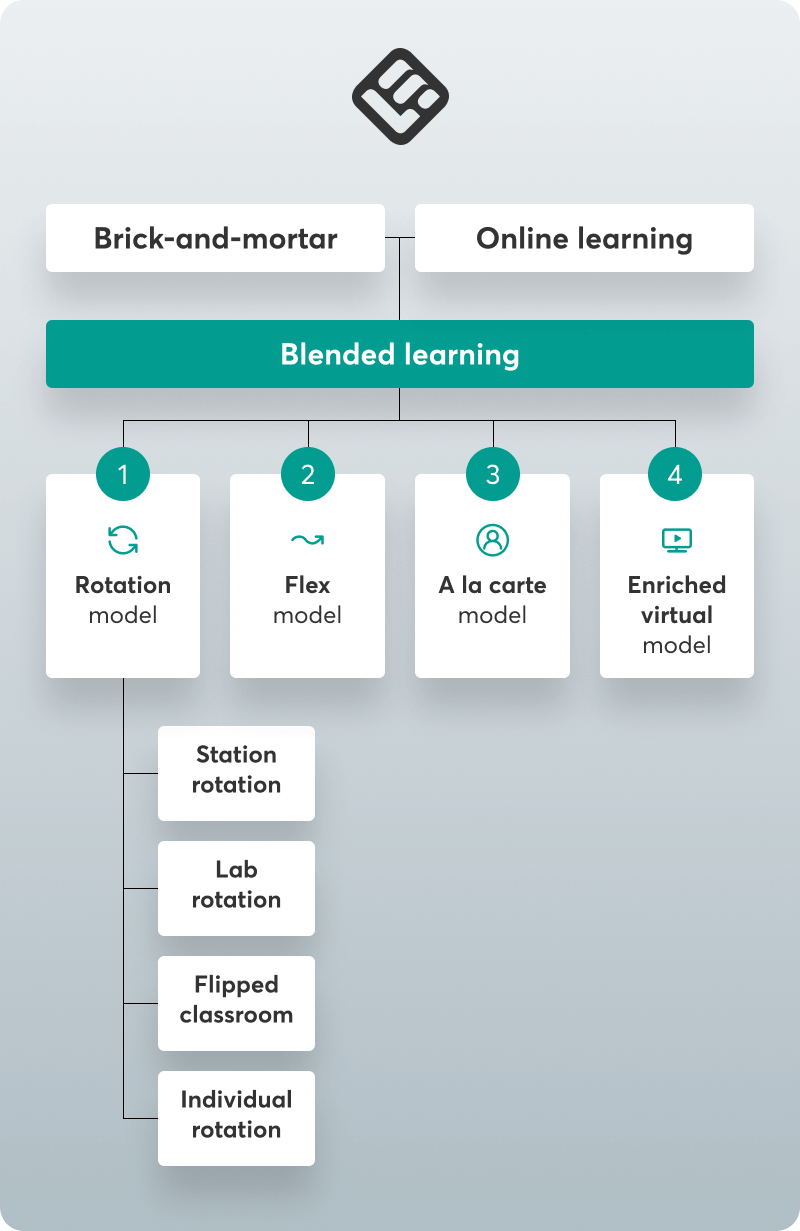
Let’s discuss each one of these models in more detail.
1. Rotation blended learning model
In the rotation blended learning model, students rotate on a fixed schedule or as the teacher advises, between learning modalities, at least one of which is online learning. Other modalities include face-to-face instruction, working in a small group or full class through group work/projects, 1:1 tutoring, and pencil-and-paper assignments. Students mostly learn by attending a brick-and-mortar school.
As the graph above shows, the rotation model has four different subcategories that are worth exploring further.
Within this educational framework, it’s crucial to consider the role of technology in supporting these methods.
This involves integrating digital signage, interactive displays, and online learning platforms for efficient information dissemination and an enhanced learning environment.
Station rotation
Most commonly used in elementary schools, the station rotation model allows students to rotate through stations within a classroom as group members.
Lab rotation
This model requires students to rotate to a computer lab for the online learning station. It offers flexible scheduling arrangements with teachers and paraprofessionals.
Individual rotation
It allows students to rotate through stations, but only on the stations that are set by the teacher or software algorithm. Students don’t need to rotate to every station, but only to the individual activities scheduled on their playlists.
Flipped classroom
This model ‘flips’ the traditional role of each learning space. Students get to learn from home through online coursework and watching lectures, and they engage in group exercises, projects, and discussions with the guided support of the teacher.
The flipped classroom is a favorite amongst teachers and students, and it looks like it will be the future of education. This is because it effectively uses the two ends of the spectrum—online and offline learning.
💡Keep learning: The rise of artificial intelligence in education: Will AI disrupt elearning?
2. Flex model in blended learning
The flex model in blended learning allows students to have more control over their learning. Most learning happens online, but there are instances where additional face-to-face support and class-time instruction are needed. Students learn as part of a fluid schedule that is customized to each individual.
3. A La Carte model in blended learning
The A La Carte model in blended learning—most popular in high schools—offers students the flexibility to take an online course with an online teacher of record that complements the learning experiences of face-to-face courses at a brick-and-mortar school.
4. Enriched virtual model in blended learning
The enriched virtual model in blended learning allows students to complete the majority of their coursework online but also attend school for face-to-face learning sessions. This model doesn’t require daily school attendance like the flipped classroom, but it’s not a fully online course either because some kind of attendance, eg twice a week, is required.
All of these blended learning models have a common goal. That is to move from a teacher-centered to a more learner-centered approach, improving student success.
Edutopia explains how this is possible through blended learning.
How can you offer a blended learning course?
Perhaps the biggest consideration when it comes to using blended learning strategies is that it is hugely based on technology. This can be a challenge for teachers and students who aren’t tech-savvy because it forces them to learn how to use it.
This means that your learning center, school, or organization needs to leverage digital tools that are:
Choosing the right technology that checks all of these three points is critical to any successful education program.
Any technical issues occurring from a learning software that is not accustomed to the elearning standards, like SCORM, won’t bring the results you expect either.
To be able to offer a blended learning course, you will need to make use of educational technology. In fact, you will need a Learning Management System (LMS) or a learning platform that offers an impactful solution. An LMS is a must once you decide that the blended training approach is the best for your learners, employees, or even customers.
Many blended learning platforms can help you offer online learning, but also help you prepare materials as part of a blended curriculum that can take place outside of the traditional classroom. Our very own platform, LearnWorlds, comes with a powerful set of features and tools, including analytics and reports that can help you deliver blended learning and monitor learner progress and program effectiveness.
Here’s what you need to do to start your blended learning course.
1. Make use of the Interactive Video
Interactivity is important when discussing online learning since it helps to improve student retention and motivation.
With LearnWorlds, you can deliver unique learning experiences using interactive video. Interactive video allows you to add questions in the video flow, allowing learners to click on them to answer questions.
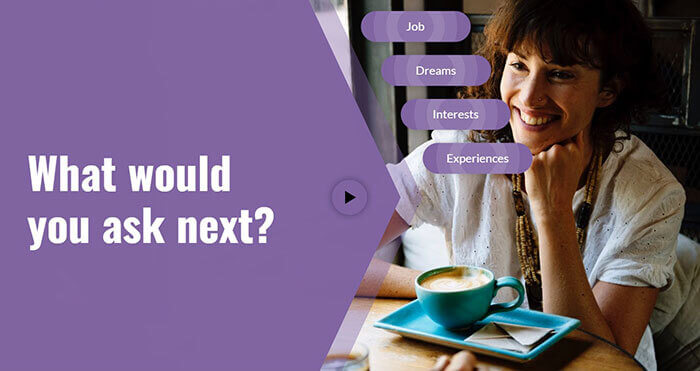
Apart from that, it also comes with interactive subtitles and transcripts, which aim to make it easier for teachers to teach students of any level. Here are a few amazing things you can do with interactive video transcripts:
2. Learn through a customizable course player
Use LearnWorlds’ course player to deliver your online course and simplify the learning process for your students when implementing blended teaching.
The course player offers the possibility to create a learning path for each learner or group of learners. As a teacher/trainer, you can select whether learners will navigate freely, sequentially, or even set their own restrictions.

With drip feeding, you can also control which content or learning materials your students can access and when.
Last but not least, it allows learners to take notes or highlight key terms and ideas while reading the text.
3. Create learning activities to test knowledge
In terms of learning, you can create a variety of tests and quizzes to assess your students’ knowledge.
From informal quizzes that evaluate self-improvement to formal tests, questionnaires, and assignments relating to critical thinking and the attainment of skills, the choices are endless.
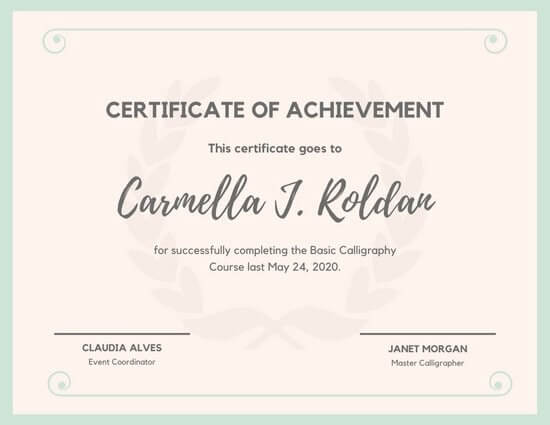
Upon completing the education program or online course, you can also offer a course certificate as evidence of participation and success in the blended learning program.
4. Build a thriving online community
With LearnWorlds, you get to build an inclusive blended learning environment where learners can easily interact with and learn from each other.
This is possible through the community page that you can find in your school’s dashboard as a LearnWorlds user.
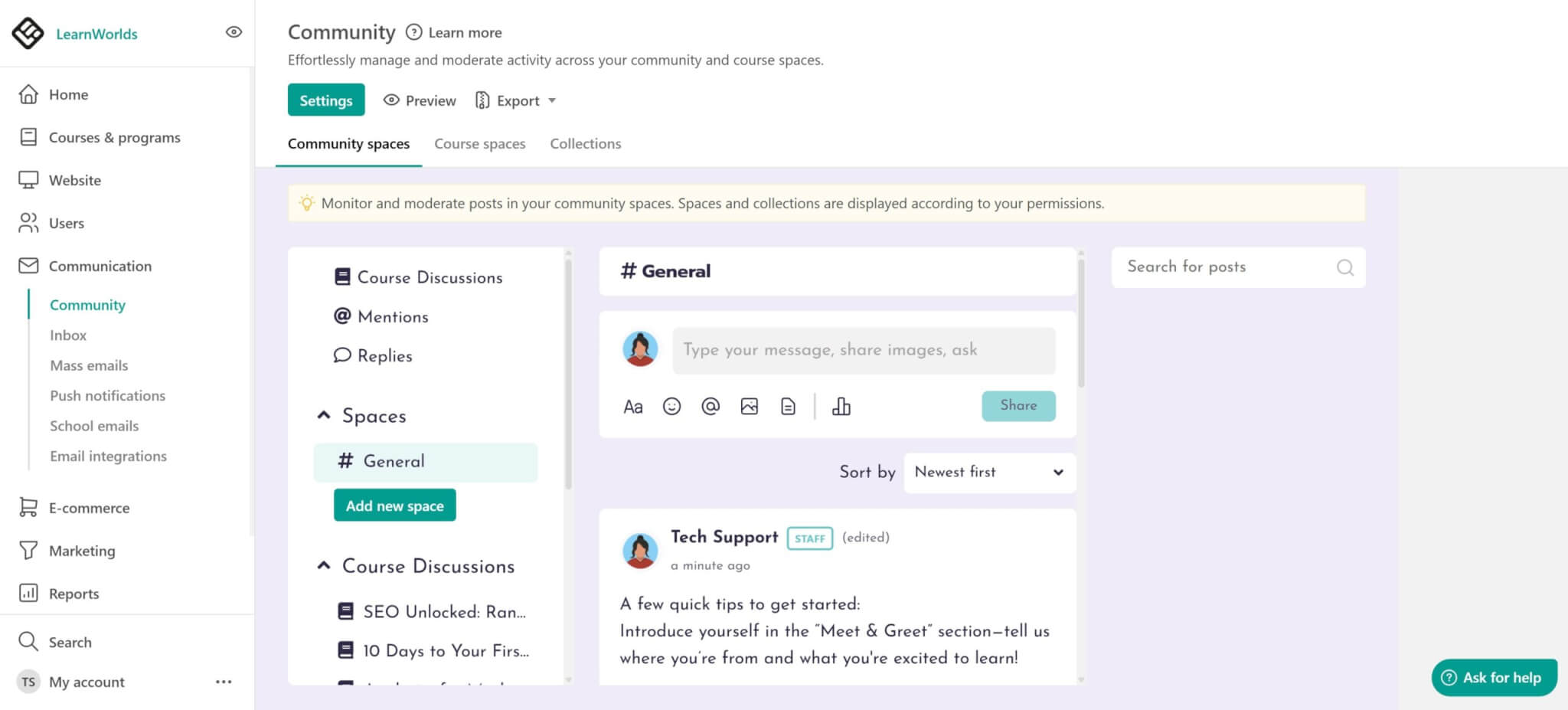
As part of the online community, learners can create their own profiles, comment, like, or follow other classmates. They can also reach out to others individually or as part of a group through course discussion groups.
💡For more information on the community page, visit our Community and Groups support article.
Blended learning examples in corporate environments
Blended learning is also widely used in corporate training programs to improve flexibility, engagement, and knowledge retention.
These practical blended learning examples tailored to corporate settings show how different models help you meet specific training goals:
What are the best tools for blended course delivery?
A strong learning program relies on the right combination of blended learning tools to support both online and in-person instruction. The best tools for blended course delivery are:
For any blended learning academy, the right tools can help deliver high-impact training at scale. Look for solutions that support integration, mobile access, and data tracking to ensure a seamless learner experience.
Looking for an LMS for blended learning? Get to know LearnWorlds
Traditional face-to-face learning is very different from elearning, but when these two approaches are combined, they are super powerful. Blended learning is here to stay, and as we move forward into the digital age, more schools and organizations that offer online training will be investing in it.
If you are an educator who wants to build an online school that complements classroom instruction, hosts and distributes engaging course material, and creates high-quality online resources, you need to invest in a reliable online learning management system like LearnWorlds.
LearnWorlds comes with all the features you can find in any LMS and flexible course creation tools to help you create unique and unforgettable learning experiences.
Experience LearnWorlds’ LMS for blended learning today with a free 30-day trial.

Kyriaki is the Organic Content Strategist at LearnWorlds, where she writes and edits content about marketing and e-learning, helping course creators build, market, and sell successful online courses. With a degree in Career Guidance and a solid background in education management and career development, she combines strategic insight with a passion for lifelong learning. Outside of work, she enjoys expressing her creativity through music.
 Back to blog
 Scroll to top
FAQ
Everything you have ever wondered, but were too afraid to ask...

Related Articles